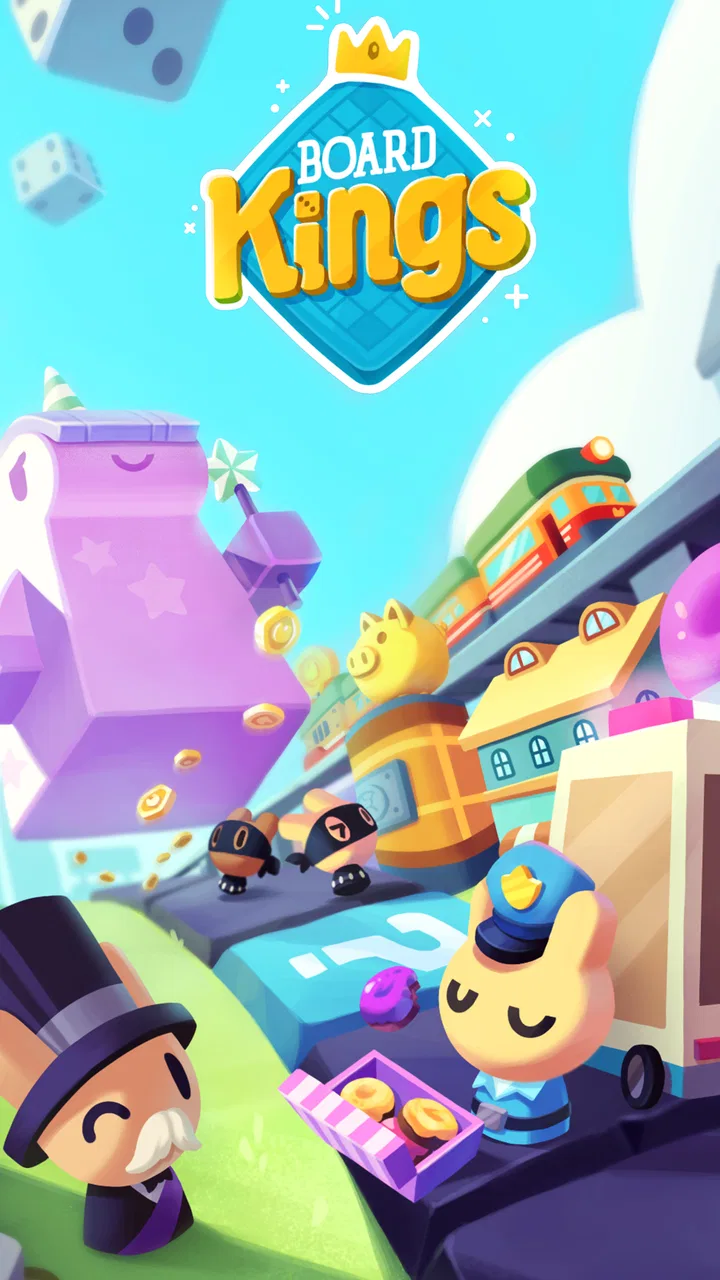
Board Kings: Board Dice Games
- 4.7
- Rating
- 50.00M
- Installs
- Free
- Price

 Analysis by App-foxy
I spent time with Board Kings: Board Dice Games as a casual board game, and my first impression was that it is built around short bursts of play rather than long, uninterrupted sessions. You roll, make choices around your board, and gradually turn a simple dice-based idea into a more active routine. That makes it easy to open when I have a few spare minutes, although the game also has enough progression and collection appeal to encourage repeated visits.
Developed by Playtika, this free board game is aimed at Everyone and runs on Android devices using version 8.0 or later. It has reached over 50 million installs and holds a 4.7 average from around 818 thousand ratings, which gives a useful sense of its broad appeal. Those figures do not automatically make it right for everyone, but they do suggest that the basic loop is easy for many players to understand.
How Board Kings feels in everyday play
The central appeal is the combination of dice rolls and board development. I like that the game does not ask me to master complicated controls before I can begin. The interaction is familiar: roll, see where the turn takes me, and decide how to use the result within the wider progression. That simplicity is a strength when I want something light, especially compared with board games that require several minutes of setup or a full group of people.
You May Also Like

 AccuWeather: Weather Radar
AccuWeather Review: A Quick, Clear Forecast for Everyday Decisions
For everyday plans, the best forecast is the one you can understand quickly. AccuWeather makes rain timing, radar, and local conditions easy to act on, with a few trade-offs.

 Hill Climb Racing
Why Hill Climb Racing Still Turns Crashes Into One More Run
A tiny car, a bumpy hill and one more upgrade: Hill Climb Racing keeps resurfacing because its simple chaos makes every near-miss feel personal.

 AliExpress - Shopping App
AliExpress Makes Global Shopping Feel Personal, but Shoppers Bear the Risk
AliExpress turns a global marketplace into a pocket-sized discovery engine. Its reach is useful, its shopping loop compelling, and its trade-offs easy to miss.

 Lords Mobile: Kingdom Wars
Lords Mobile Is a Kingdom-Building Routine, Not a Quick Match
A case-by-case verdict on the building, battles, device demands, and social commitments that make Lords Mobile rewarding for some players and exhausting for others.

 PDF Scanner app - TapScanner
TapScanner Makes Paperwork Easier to Capture, Check, and Share
TapScanner makes scanning with a phone feel less like a rescue operation and more like a dependable step in getting work done. Its capture tools are useful, though not flawless.

 Block Blast!
 Shows How Much a Puzzle Game Can Leave Out
A quiet grid game shows why puzzle players increasingly value instant clarity, repeatable skill and low-pressure play—and where the genre still needs to catch up.
More From Our News Desk
View All News


A realistic use case is a commute, a lunch break, or a few minutes while waiting for an appointment. I can pick it up without preparing a table, finding opponents, or remembering a long rulebook. The game works better as a regular check-in than as a replacement for a traditional evening board-game session with friends. If you want conversation, negotiation, and face-to-face competition, a physical game or a multiplayer title with deeper direct interaction may be more satisfying.
The early experience is approachable, but the long-term appeal depends on whether you enjoy gradual board growth and repeated rolls. Players who like watching a personal game space develop will probably find a reason to return. Players who need constant novelty, precise strategy every turn, or a clear match ending may find the loop less rewarding after the initial curiosity fades.
Speed expectations during short sessions
In my experience, the perceived pace is shaped less by complicated controls and more by the rhythm between rolls, rewards, and decisions. Individual actions feel naturally suited to quick play. I do not need to spend a long time navigating menus before reaching the part that matters, which is important for a game designed around casual visits.
That does not mean every session feels equally fast. A short visit can become longer when I start checking progress, considering the next move, or following several reward moments in sequence. The game’s accessible structure makes it easy to begin, but it can also encourage “one more turn” behavior. I would describe it as brisk for a quick check-in, with a more leisurely pace when I become invested in improving the board.
One practical tip is to treat a brief session as a defined activity rather than opening it without a limit. I get more enjoyment when I decide beforehand that I am going to complete a small round of actions and then stop. That approach keeps the casual design working in my favor and prevents the game from taking more attention than I intended.
What happens when play becomes heavier
Longer use places a different demand on the experience. Repeated rolls, board development, reward collection, and menu movement can make the game feel busier than its basic dice concept suggests. The challenge is not learning the rules; it is deciding how much time and attention I want to give to a loop that is deliberately easy to repeat.
I also pay closer attention to the economy during extended play. The game is free to download, but it includes purchases ranging from $0.99 to $199.99 per item. That wide range matters because a player who only wants occasional entertainment can approach the game very differently from someone tempted to accelerate progress. I recommend deciding early whether spending is part of your plan. If it is not, keeping purchases protected through your device settings is a sensible habit.
This is one of the more important trade-offs in the design. The free entry makes it easy to try, while the presence of optional purchases means the most comfortable experience depends on personal discipline. I would not recommend it to someone who dislikes games that place visible emphasis on optional spending, even if that player enjoys dice and board mechanics.
Stability and recovering after interruptions
For ordinary use, I judge a casual game by how little friction it creates when I return to it. Board Kings benefits from having a straightforward central activity: I can usually understand what I was doing without reconstructing a complicated battle plan. That makes it more forgiving than a strategy game where an interruption can leave me unsure about the next objective.
Short mobile sessions are often interrupted by calls, messages, travel, or simply locking the screen. A game with simple turn-based actions is naturally easier to resume than a fast real-time title. I still prefer to finish an active action before switching away, because that reduces the chance of losing track of what I intended to do. The best recovery workflow is simple: complete the current roll or decision, leave the game, and return later rather than repeatedly suspending it mid-action.
I would avoid making strong promises about stability on every phone, because performance can vary with device age, available storage, the operating system, and other apps running at the same time. The important point is that its casual structure makes ordinary interruptions less stressful than they would be in a competitive real-time game. If a session is interrupted, I am not usually losing the social momentum of a group match or the timing of a difficult action.
Device limits and practical expectations
The minimum operating system is Android 8.0, so owners of older Android hardware should check compatibility before planning to use it. That requirement is not especially demanding for many current devices, but it does exclude some older phones and tablets. On a supported device, I would still keep the system reasonably clear of background activity if the game feels slow, especially when switching between several demanding apps.
Because this is a board game rather than a visually intense action title, I see it as a sensible candidate for casual play on a broad range of supported devices. That is an expectation, not a guarantee for every model. Older hardware may take longer to open or may feel less comfortable during extended sessions, while newer devices are more likely to provide a smoother experience when the game is combined with normal multitasking.
Resource demands also include attention and battery habits, not just hardware. Repeatedly reopening any game throughout the day can become more noticeable than one short session. I find it better to group play into a few intentional visits instead of constantly checking for something new. This is a small change, but it makes the game feel less intrusive and gives the board progression a clearer purpose.
Useful habits for getting more from the board
My first useful habit is to separate progress from impulse. A roll can feel exciting, but not every available action deserves immediate attention. I get more value when I look at the board as a developing project and decide what I want the next session to accomplish. That mindset makes the game feel less like a series of unrelated taps.
Second, I would use it as a companion activity rather than as the only thing happening during a long break. Its short-action format suits listening to music, waiting for transport, or taking a brief pause, but I would not recommend playing while walking, driving, or doing anything that requires concentration. The game is easy to resume, so there is little reason to risk distracted use.
Third, I would review purchase habits after the first few sessions rather than waiting until I feel stuck or impatient. Since individual purchases can be as low as $0.99 and as high as $199.99, the sensible choice is to decide what “free play” means to me before the game’s progression becomes emotionally important. This is especially useful on a shared device or for younger players, even though the content rating is Everyone.
Finally, I would keep the app updated when a newer version is offered through the normal store process. The current version is 5.47.0, and using a current release is generally the most sensible way to avoid problems caused by an outdated installation. I would also restart the app if it behaves unusually before assuming the phone itself has a serious problem.
Who will enjoy it, and who should skip it?
I think it is a good match for players who enjoy dice, light board progression, and frequent short sessions. It is also suitable for people who want a game that can be understood quickly without gathering friends around the same table. The Everyone rating makes it approachable for a wide audience, although adults should still be aware of the in-app purchase structure when the game is used by children.
It is less suitable for someone looking for a traditional board-game simulation with a fixed beginning and end. A physical board game offers more direct social contact, while a deep digital strategy game offers more control over each decision. A conventional puzzle game may also be better if you want every move to depend mainly on skill rather than on a dice-driven outcome.
I would also tell competitive players to set expectations carefully. The appeal here is the ongoing board routine, not the intense pressure of a ranked match. If your favorite part of board gaming is reading opponents, planning several turns ahead, and winning through exact tactical choices, this may feel too dependent on chance and repetition.
How it compares with familiar board-game alternatives
Compared with a physical board game, this title removes setup, cleanup, and the need for other people to be available. That convenience is its clearest advantage. The trade-off is that digital progression can feel less tangible, and the presence of in-app purchases changes the way I think about advancement compared with buying one boxed game and owning the whole experience.
Compared with classic digital board games that reproduce a single known tabletop system, Board Kings feels more like an ongoing personal routine. I am not simply completing one match and putting it away; I am returning to a board that develops over time. That is appealing if I like continuity, but less appealing if I prefer a clean reset after every game.
Compared with fast multiplayer games, it is calmer and easier to interrupt. I do not need the same level of reflexes or uninterrupted concentration. The downside is that it may not provide the same sense of immediate competition or dramatic skill expression. Choosing it over another board game therefore depends on whether convenience and progression matter more to me than direct social play or strict tactical control.
What the ratings and version details mean in practice
The game has around 100 thousand written reviews alongside its large rating base, and that combination suggests a substantial amount of player feedback rather than a tiny early audience. I treat the 4.7 average as encouraging, but not as proof that every player will enjoy the same pacing or purchase model. High ratings often reflect how well a game serves its intended audience, and its intended audience appears to include people who like casual, repeatable board play.
Playtika has kept the title available across a large installed audience, while the current release remains compatible with Android 8.0 and later. For a prospective player, the practical questions are simpler than the numbers: does the phone meet the operating-system requirement, is there enough room for another game, and am I comfortable with optional purchases? Answering those questions before installing avoids most disappointment.
The game is free, which makes trying it straightforward. I would still describe “free” as an entry point rather than a promise that every form of progress will feel equally comfortable without spending. Players who are happy to move at the game’s natural pace can approach it casually; players who dislike any temptation to buy boosts or convenience should think twice before committing time to it.
My performance verdict
Board Kings works best as a light, repeatable board game for supported Android devices. Its dice-based interaction is easy to start, its short actions fit everyday gaps, and its continuing board development gives the experience more staying power than a single disposable round. I also appreciate that interruptions are less disruptive here than in a real-time game.
The main limitations are equally clear. Longer sessions can turn a simple idea into a repetitive routine, chance may matter more than players who prefer exact strategy would like, and the in-app purchase range requires sensible boundaries. Device performance can also differ, particularly on older hardware, so I would not judge the experience solely by how it behaves on one phone.
My recommendation is to try it if you want a convenient dice-and-board game that fits around daily life, not if you are searching for a fully social tabletop replacement. I would begin with short sessions, decide on a no-spending or fixed-spending rule, and pay attention to whether the ongoing board progression genuinely keeps me interested. If it does, this is an easy game to keep nearby for spare moments. If it does not, a traditional board game or a more skill-focused digital alternative will probably offer a better use of my time.
FAQs for Board Kings: Board Dice Games
01What is the main objective of Board Kings?
Board Kings is a multiplayer board game where the main objective is to build and upgrade your board while collecting coins and gems. Players roll dice to move around the board, land on various tiles, and unlock unique features. The aim is to expand and enhance your board, making it the envy of your friends.
02How does the multiplayer aspect work in Board Kings?
Board Kings allows you to compete with friends by invading their boards and collecting resources. You can visit friends' boards, steal their coins, and even damage their properties. The game encourages social interaction by rewarding players for connecting with others and comparing progress on leaderboards.
03Are there any in-app purchases in Board Kings?
Yes, Board Kings offers in-app purchases. Players can buy coins, gems, and special packs to speed up progress and unlock exclusive items. While the game is free to download and play, these purchases can enhance the gaming experience by providing additional resources and customization options.
04Is Board Kings suitable for children?
Board Kings is suitable for children, but parental guidance is recommended. The game features cartoonish graphics and playful themes, making it appealing to younger audiences. However, the inclusion of in-app purchases and social features means parents should monitor gameplay to ensure a safe and controlled experience.
05What are the system requirements for Board Kings?
For Android devices, Board Kings requires Android version 5.0 or higher, and for iOS devices, it requires iOS version 10.0 or later. The game is optimized for both smartphones and tablets, providing a seamless experience across different devices. Ensure your device has sufficient storage and is updated to the latest OS for optimal performance.
Pros
- Engaging multiplayer interactions.
- Variety of boards keeps gameplay fresh.
- Frequent updates with new events.
- Cute graphics and lively animations.
- Rewards system encourages daily play.
Cons
- In-app purchases can be costly.
- Requires a stable internet connection.
- Ads can interrupt gameplay.
- Limited offline functionality.
- Progression can feel slow without spending.

Board Kings: Board Dice Games
Gallery